Archive for Post-War
July 28, 2010 at 6:38 am · Categories: Colombo, Media and Communications, Post-War | by Sunanda Deshapriya
The recent announcement of Government of Sri Lanka’s (GOSL) intention to establish a Media Development Authority (MDA) in Sri Lanka could be taken as an indication of its approach towards media in the context of post-war economic development. An official statement posted on 25th July 2010 on a government news portal shows that the proposed authority will be modeled on along the lines of the MDA of Singapore.
The sections dealing with the policy of MDA SL is almost copied word by word from the wikipage on the Singapore MDA, which in turn is based on the official Singapore MDA site.
Here are some examples:
“MDA will play a vital role as an umbrella organization for all kinds of media in …
July 25, 2010 at 12:35 pm · Categories: Peace and Conflict, Politics and Governance, Post-War, Reconciliation | by Lionel Bopage
Good Afternoon, Ladies and Gentlemen and dear friends
I want to start my talk by bringing to the fore the experiences of another, which was seen as an intractable conflict – the apartheid struggle in South Africa.
In 1984, Mandela single handedly launched negotiations with the Afrikaner government. His reasons were simple and unambiguous.
There are many people who feel that it is useless and futile for us to continue talking peace and non-violence — against a government whose only reply is savage attacks on an unarmed and defenseless people. And I think the time has come for us to consider, in the light of our experiences at this day at home, whether the methods which we have applied so far are adequate.
He …
July 22, 2010 at 12:01 am · Categories: Colombo, Constitutional Reform, Peace and Conflict, Politics and Governance, Post-War | by Groundviews

Released exclusively on Groundviews, this is a composite document compiled by Yogarajan and Kariapper and made public by them (read the full background to this document in their introduction).
Please note that as Nizam Kariapper pointed out to Groundviews, there is a mistake in the first page of this version of the report – the reference to June 2010 should read as June 2009.
- Download the complete report here.
- Download the executive summary of the report here.
July 21, 2010 at 7:45 pm · Categories: Colombo, Peace and Conflict, Politics and Governance, Post-War, Reconciliation, Sport | by Kumsyoh
Some excellent goals scored, some unbearable moments of anguish celebrated as teams win and lose in an imperfect system, some stunning comebacks, terrible bouts of pain vanishing instantly once the arbitrator with a whistle awards a free kick, the tears of the Japanese, the despair of the Ghanians’, incompetent referees sent out to save face, all making a wonderful festival of sport. All in all we have been witness to a wonderful world cup. FIFA president Sepp Blatter called it an emotional one. Emotional because we saw more than soccer in South Africa. We saw a nation healing. We witnessed what could be an answer for the modern tribalism, which is engulfing our world.
It was seen in a flag being …
July 20, 2010 at 4:12 pm · Categories: Colombo, Constitutional Reform, Peace and Conflict, Politics and Governance, Post-War | by Groundviews
This interview features Dr. A. C. Visvalingam, President, Citizen’s Movement for Good Governance. I ask him about his advocacy and activism in Sri Lanka, both during war and post-war. Mr. Visvalingam bemoans the fact that a number of articles, despite close ties to Editors and journalists, did not appear in the newspapers, and also speaks of the corporate sector’s risk averse nature especially around content produced that is critical of government and governance. He also speak about the need to introduce civic education in schools to bring about a greater awareness over the role and responsibilities of citizens. He goes on to …
July 20, 2010 at 3:11 pm · Categories: Colombo, Diplomacy, International Relations, Peace and Conflict, Politics and Governance, Post-War, War Crimes | by Kalana Senaratne
Dr. Lakshman Marasinghe (Emeritus Professor of Law, University of Windsor) in an article titled ‘Some Random Thoughts on the UN International Advisory Panel’ (Daily Mirror, 14 July, 2010), makes a serious suggestion to the Government; i.e. to obtain an Advisory Opinion (AO) from the International Court of Justice (ICJ) at The Hague, to determine “whether it was within the power of the Secretary-General to appoint an Advisory Panel mandated as he has when appointing it.” He admits that he is “unable to suggest a political solution” to what he considers to be a matter which raises an “interesting point of international law.”
Dr. Marasinghe’s suggestion, in turn, raises greater problems, and is a risk that Sri Lanka cannot afford to take …
July 18, 2010 at 6:30 am · Categories: Ampara, Batticaloa, Foreign Relations, Jaffna, Peace and Conflict, Politics and Governance, Post-War, Trincomalee, Vavuniya, War Crimes | by Dayan Jayatilleka
When faced with challenging human rights and humanitarian law issues who should we seek out for advice but a celebrated former Vice President of the International Court of Justice? Faced with the task of peace building after a Thirty Years war, to whom should we turn to spearhead a state-aided national effort, or at the very least, for ideas and guidance, but the sole Sri Lankan to win the UNESCO Prize for Peace Education? If the Sri Lankan state and society have done neither, what does that say about us, where we are at and where we are headed?
One of the more refined gratifications in my life is the friendship of a few renowned intellectuals like Richard Falk, Emeritus Professor …
July 15, 2010 at 3:11 pm · Categories: Identity, Peace and Conflict, Politics and Governance, Post-War | by Dhammika Dharmawardhane
The swift annihilation of the Tamil Tigers was a surprise to me. A war that was 30 years long, finished so quickly with an undignified death for the leader of the LTTE. Yet, so many unanswered questions.
The man on the street, people like myself, we’ll never know the whole truth. Some of us don’t care, terrorism, the LTTE were wiped out. That’s all that matters. We celebrated the great victory. In my corner of the stix in England, I celebrated the new sovereignty of my motherland, my country, my Paradise Island. My tears of joy like acid on their faces for the Tamil Diaspora.
It’s easy for me, for I don’t live there anymore. I am but the tourist who returns …
July 11, 2010 at 6:30 am · Categories: Colombo, Peace and Conflict, Politics and Governance, Post-War, War Crimes | by Dr. P. Saravanamuttu
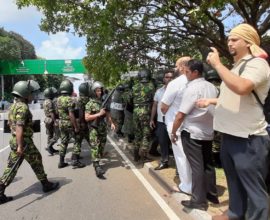
The declared threat, the demonstration, siege, fast unto death outside the office of the UN in Colombo by the Wimal Weerawansa led National Freedom Front, raises interesting and alarming questions about policymaking in our country.
Wimal Weerawansa announced that he would call upon his supporters to surround the UN office until the UN Secretary General disbanded the advisory panel he has set up on alleged war crimes in Sri Lanka. It was reported that the Government of Sri Lanka (GOSL) had informed the UN that these were the views of an individual and not that of the GOSL. Days later, Weerawansa, a cabinet minister and key supporter of the president and regime, leads a demonstration of hundreds to the UN office, …
July 10, 2010 at 7:00 am · Categories: Colombo, Foreign Relations, International Relations, Peace and Conflict, Politics and Governance, Post-War, War Crimes | by Chaminda WEERAWARDHANA

Photo courtesy Vikalpa’s Flickr photostream on the NFF protest
The point of departure for this note is the fast unto death by a government (cabinet) Minister, hereinafter referred to as VW, in front of the UN’s Colombo office. The protest campaign launched by the said individual, and his decision to fast, are meant at demonstrating his party’s (and, being a vocal member of the governing coalition, the present government’s) opposition to the investigative panel appointed by the UN SG on alleged war crimes during the last phase of civil war in early/mid 2009.
The UN SG has been functioning under prerogatives accorded to him in his mandate. The most recent …
July 10, 2010 at 6:51 am · Categories: Colombo, Peace and Conflict, Politics and Governance, Post-War, War Crimes | by Groundviews
The National Freedom Front (NFF), in a procession from Bullers Road, approached the Russian Embassy today and met with officials inside the premises. The second day of Wimal Weerawansa’s fast unto death (and the third day of NFF’s agitation in front of the UN in Colombo) saw him call a press conference in the afternoon.
In his physically weakened condition, what he said was not voluble enough to be captured by Vikalpa’s video camera. However, a woman’s strident and emotionally charged call to save his life at the end of the video captures the essential volatility of the situation in front of the UN, and …
July 6, 2010 at 6:37 pm · Categories: Colombo, Peace and Conflict, Politics and Governance, Post-War, War Crimes | by Groundviews
Photos courtesy Vikalpa, and more will be added anon. Others taken by blogger Indi Samarajiva can be seen here.
Google has the latest updates from all web media, including tweets and blogs. Our curated Twitter news feed also features the latest updates from sources like @DMbreakingnews….
July 5, 2010 at 6:30 am · Categories: Colombo, Jaffna, Peace and Conflict, Poetry, Politics and Governance, Post-War, Vavuniya | by Indran Amirthanayagam
There is no rule written in an enormous ledger by an acolyte angel
that says a poet will write every day until death. The uncivil war will end
according to absence of such dictate when humours start to break down
cellular walls and cancer spreads overcoming defences of heart, lungs,
kidneys, gut, brain, in no particular order, as aforementioned parts
succumb to constant hammering of shells, fits of barking orders to kill,
and distant turning away from disaster, beating breasts, while asking
focus groups, how can we intervene in a sovereign nation, does this
particular wilful disregard for human life meet your standard, fellow
citizens and friends? Pure fantasy. Nobody consulted the man in Peoria
or the soothsayer shuffling along to the bead shop on Main …
July 1, 2010 at 2:00 pm · Categories: Colombo, Media and Communications, Post-War | by Chaminda WEERAWARDHANA
NB: The following is a brief (and therefore rather incomplete) note on the censorship and state-control imposed on present-day Sri Lankan cinema, where filmmakers are forced to be conscious of the prevalent political discourse on artistic expression. Hiding behind a so-called (‘Victorian-inherited’) culture and blocking creative energy being an act of sheer hara-kiri on artistic expression, it is sincerely hoped that this note would lead to a more consistent dialogue among GV readers on artistic expression, especially in terms of Sri Lankan cinema.
It is deeply hoped that someone attached to the current regime in a policymaking capacity would come across what follows. If one takes a look at Sri Lankan video websites like col3neg and srilankantube largely meant for …
July 1, 2010 at 11:30 am · Categories: Colombo, Diplomacy, International Relations, Peace and Conflict, Politics and Governance, Post-War | by Dayapala Thiranagama
Indo- Sri Lanka relations made a dramatic and unprecedented change with the beginning of the Eelam war. This change contributed to bringing about far reaching military and political consequences within Sri Lanka and its two destructive wars. The JVP led anti-devolutionary Sinhalese rebellion had been the direct result of the changed Indian policy. The most destructive Eelam war was the other. These developments have fundamentally shaped the future course of Sri Lankan politics. Since 1983 India had begun supporting the Tamil militant groups to train and arm its cadres for military confrontations with the Sri Lankan state. Their bases in Tamil Nadu provided a rearguard and they could retreat safely to these bases after mounting deadly attacks to the Sri …
July 1, 2010 at 10:15 am · Categories: Colombo, Constitutional Reform, Development, Diplomacy, Economy, End of war special edition, Foreign Relations, Gender, Human Rights, Human Security, IDPs and Refugees, Identity, International Relations, Media and Communications, Peace and Conflict, Poetry, Politics and Governance, Post-War, Reconciliation, War Crimes | by Groundviews

Download the 162 page compilation of content as a PDF in high quality (25.4Mb), or low quality (3.7Mb). The low quality version is good enough to read, but the photos will look and print much better in the high quality version.
From 19 – 27 May 2010, Groundviews ran a special edition on the end of war in Sri Lanka. Over this week alone, the site received over forty thousand readers and exclusively featured over eighty thousand words of original content, one video premiere, over a dozen photos, generating over one hundred and fifty thousand words of commentary. Tens of thousands more have read …
July 1, 2010 at 6:30 am · Categories: Fiction / Creative Writing, Peace and Conflict, Post-War, Vavuniya | by Gypsy Bohemia
He was a filmstar, they said. But she had never much cared for films. She had heard of schoolgirls hoarding dog-eared posters; giggling over provocative poses; singing the songs the stars sang; dancing the dances the stars danced; wishing for the same clothes and hair styles. She had heard stories of the glitz and glamour of that faraway world. But they meant nothing to her. Her school days hadn’t lasted long. She hadn’t the time to grow up, watching films and singing songs.
Time was snatched from her and replaced by a gun in her hands. A gun could stop time, she was told. And it had. She knows it has been years since she’d pulled a trigger for the first …
June 30, 2010 at 6:30 am · Categories: Colombo, Constitutional Reform, Peace and Conflict, Politics and Governance, Post-War | by Leela Isaac
The present Sri Lankan government has proved that though Sri Lanka is a small country, it has been able to achieve many things that other countries, specially in the West have not been able to. Nowhere in the world has terrorism been crushed and destroyed using only force. “Destroying terrorism is not a crime” the Defense Secretary told Stephen Sackur of the BBC. What was implied is that the means we used cannot be questioned. In other countries a military solution goes hand in hand with a political solution. In Sri Lanka the government believes that there is no political problem and therefore a political solution is not necessary. If that is so what made the LTTE take up arms? …
June 27, 2010 at 10:51 pm · Categories: Colombo, Development, Post-War | by Mihirini de Zoysa
It’s February 14th, Valentines day and I am browsing the net, going from one link to the other, without a particular destination, enjoying tidbits from the cyber world.
I happen to come across an interesting TED talk http://on.ted.com/88Xq. Its about a school in India (Riverside School) that starts a program called I Can, where children aged 8 – 14, in small groups are empowered and inspired to become change agents. It’s a simple concept. The children are asked to pick an issue that bothers them, that they want to change, and then they are given a week to make the change. The impact and results are amazing. From cleaning up garbage, to making cities child friendly, to stopping child …
Next entries »